Most people think of email as just another account.
You have a Facebook account. A bank account. A Microsoft account. A Dropbox account. Maybe QuickBooks, Amazon, cloud storage, vendor websites, insurance portals, and dozens of other services.
And then you have email.
The problem is that email is not really equal to all those other accounts.
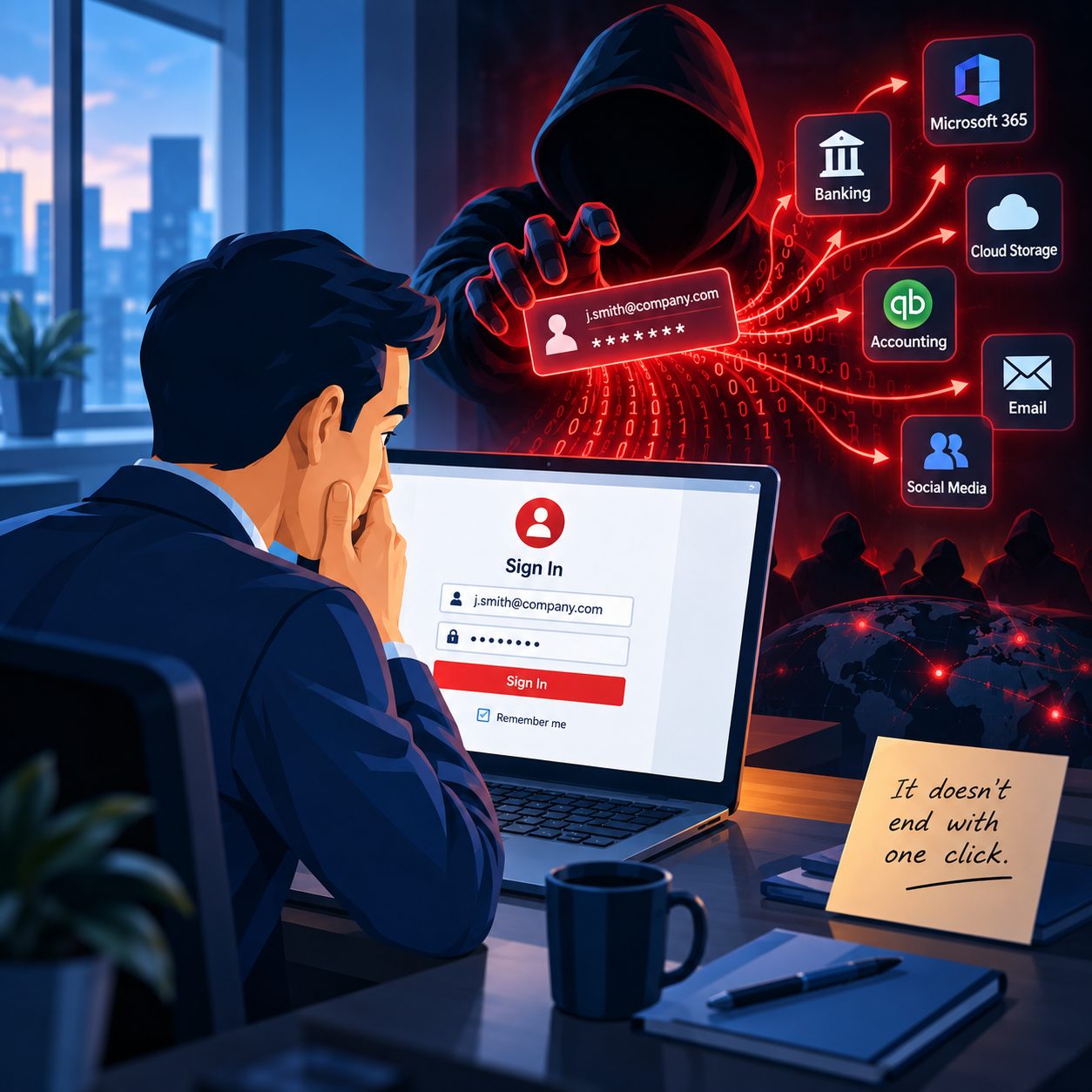
For many people and small businesses, email is the account that helps control the others.
Think about what happens when you forget a password.
You click Forgot Password.
Where does the reset message usually go?
Your email.
That simple fact changes the importance of completely protecting your inbox. The FTC specifically warns that email accounts can become a weak link in online security because password reset messages for other accounts are often sent there. If someone gains access to your inbox, they may be able to intercept those messages.
Suddenly, protecting your email is not just about keeping someone from reading your messages.
It may be about protecting a large portion of your digital life.
Imagine Someone Sitting Inside Your Inbox
Imagine giving a stranger access to your email for an hour.
They do not immediately send anything.
They do not change your password.
They do not announce that they are there.
They simply search.
They search for Microsoft.
QuickBooks.
Dropbox.
Bank.
Payroll.
Facebook.
Amazon.
Invoices.
Statements.
Insurance.
Password reset.
They look at who you do business with, where you store files, which financial institutions send you alerts, what software your company uses, and which vendors communicate with you regularly.
For a business owner, they may also discover the names of employees, clients, accountants, bookkeepers, vendors, and people who regularly receive payments.
That information can be incredibly useful to a criminal.
The FBI describes business email compromise as one of the most financially damaging forms of online crime because criminals can impersonate a trusted person or company and make requests that appear legitimate.
And that is why a compromised email account can become much more serious than someone simply reading your mail.
Your Inbox Is Often Your Digital Recovery System
Take a few minutes and think about how many accounts are connected to your primary email address.
For many people, it could include:
Microsoft 365
QuickBooks or other Intuit services
Dropbox
Google Drive or OneDrive
Social media accounts
Online shopping accounts
Vendor portals
Insurance accounts
Credit card notifications
Banking alerts
Payroll systems
Domain and website accounts
Cloud storage
Business software subscriptions
Password reset messages for dozens of other services
Not every one of those accounts can automatically be taken over just because someone has access to your email.
That distinction is important.
Many services use additional verification, multifactor authentication, phone verification, security keys, identity checks, or other protections.
But possession of your email account can potentially give an attacker a very powerful starting point.
For example, Intuit allows account recovery to begin using the email address or phone number associated with an account. Additional verification may still be required, but control of the associated email can clearly become part of the recovery process.
That is why I tell people to stop thinking about email as simply another password that needs protecting.
Your email account may function more like the front desk to your entire digital identity.
Banking Is a Good Example
People sometimes hear this discussion and assume that if someone gains access to Gmail or Microsoft 365, they can immediately transfer everything from a bank account.
That is usually an oversimplification.
Banks have their own authentication and fraud protections.
But imagine what someone might learn from your inbox.
- They may see which bank you use.
- They may see transaction notifications.
- They might find credit card alerts, invoices, receipts, account correspondence, or messages containing partial account information.
- They might learn who handles your accounting.
- They might discover that you regularly pay a particular vendor.
- They could then use that information to create a much more convincing scam.
That is often where the real danger lies.
A criminal does not necessarily need your email account to access your bank account directly.
Sometimes they need your email account to learn enough about you to attack the next account much more convincingly.
For a Small Business, It Can Be Even Worse
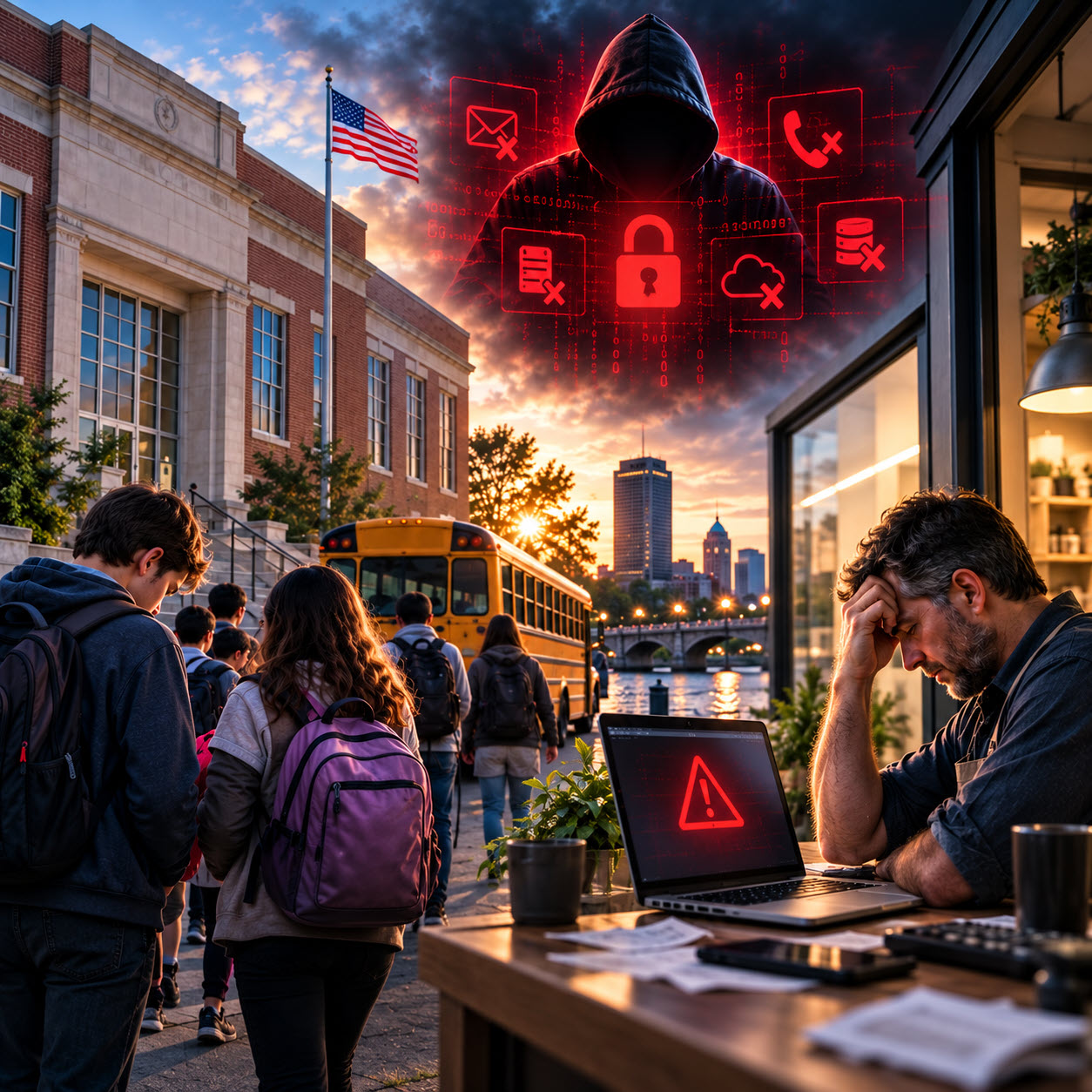
This is where email security becomes especially important for small businesses in Springfield, MA, and surrounding communities such as Longmeadow.
Your business email account may contain years of information.
- Customer conversations.
- Invoices.
- Quotes.
- Vendor information.
- Tax documents.
- Attachments.
- Schedules.
- Employee information.
- Password reset messages.
- Cloud storage notifications.
- Microsoft 365 information.
- And perhaps most importantly, relationships.
If a criminal compromises a business email account, they may not need to invent a fake identity.
They already have yours.
An email sent from your real account to a client saying, “We changed banks, please send the payment here instead,” is far more convincing than a random phishing message from someone the client has never heard of.
Business email compromise specifically takes advantage of that trust. The FBI warns that criminals can impersonate known sources and make requests that appear legitimate.
For a small business owner, the damage is not always limited to money.
It can affect something that took years to build.
Trust.
The Attacker May Not Want You to Know They Are There
One of the biggest misconceptions about hacking is that something dramatic immediately happens.
Your password changes.
Your computer locks.
A ransom message appears.
Sometimes the exact opposite is more useful to the attacker.
If they can remain undetected within an email account, they may continue to monitor conversations and gather information.
Microsoft specifically recommends reviewing forwarding settings, connected accounts, and automatic replies after recovering a compromised Microsoft account. CISA has also documented attackers using email forwarding rules to collect information and maintain visibility into a victim's communications.
That means simply changing the password may not always be enough after an actual compromise.
You need to find out what changed while the attacker had access.
A Password Alone Is No Longer Enough
A good password is important.
A unique password is even better.
But email deserves another layer of protection.
Multifactor authentication requires something beyond the password before someone can access the account. CISA recommends MFA because even when a password becomes compromised, the attacker still has another authentication requirement to overcome.
For important accounts, I generally want to see several things in place:
A strong and unique password
Multifactor authentication
Accurate recovery information
A review of suspicious sign-in activity
No unknown forwarding rules
No unfamiliar recovery addresses or phone numbers
Current computers and security software
Separate accounts for different employees rather than everyone sharing one login
The exact setup will depend on the person or business.
The important part is understanding that the email account deserves more protection than most people give it.
There Is Another Problem: Everything Is Connected
Years ago, losing an email password mostly meant losing access to email.
Today our accounts are interconnected.
Microsoft 365 talks to cloud storage.
Cloud storage contains business documents.
QuickBooks may be connected to an Intuit identity.
Social media accounts use email for recovery.
Online stores send receipts.
Banks send alerts.
Vendors communicate through email.
Website providers send account notifications.
That connectivity makes modern technology incredibly convenient.
It also means one poorly protected account can sometimes create a path toward several others.
The FTC recommends securing a compromised email account, changing its password, and enabling two-factor authentication when available.
Ask Yourself One Question
If someone got into your email tonight, what else could they reach?
Most people cannot answer that question.
And that is exactly why I think it is worth asking before a problem arises.
You do not need to become a cybersecurity expert.
You do not need to be paranoid every time an email arrives.
But you should know what protects the account that protects so many of your other accounts.
Your Email Should Be Treated Like a Master Key
You would not leave the key to your house taped to the front door because it is convenient.
Your primary email account deserves the same kind of thinking.
Especially when it belongs to a business.
If your company relies heavily on Microsoft 365, email, cloud storage, QuickBooks, or other online services, your email security should be part of your overall small business cybersecurity plan, not something you think about only after someone gets hacked.
And if you are not sure whether your accounts are properly protected, that is something worth finding out.
At Bob's Computer Service, I help small businesses and residential clients throughout Springfield, MA, and Longmeadow review their computers, Microsoft 365 security, email accounts, multifactor authentication, and other areas where one overlooked setting can create a much larger problem.
Sometimes the most valuable security work I do is not fixing something after it has gone wrong.
It is finding the weakness before somebody else does.
If you are wondering whether your email account is properly protected, give me a call. We can take a look at what protects it, which accounts depend on it, and whether there are security gaps you may not even realize.
Because your inbox may contain emails.
But the password protecting it may be guarding a whole lot more.